Wednesday, April 8, 2009

Thursday, January 29, 2009
Setting: Mood
The mood for my story is suspense. In my story a lot of people disagree with my characters for fighting for woman’s rights. My characters always have to be on the look out for anybody that might want to take action against them. For instance, they must always looking behind them when they walk alone on the streets. When Susan B. Anthony illegally voted she was sweating because she was scared that she would get caught. When she does get caught I will draw out the scene to make it more suspenseful when they bang down her front door to catch her. In Clara Barton's background it is very suspenseful because she has to be on a live battle field to save peoples lives. She is risking her own life when there are planes dropping bombs right above her head. my story will be very suspenseful.
Wednesday, January 28, 2009
Setting: Time


The time of my story is 1850. The best form of transportation was either trains or boats. Boats made slavery more noticeable. Therefore anti-slavery groups transported using boats. My first picture in the left corner is the Lois McClure. This boat has been used since 1862 and is the type of boat that people from 1850 would commonly travel on. The Lois McClure currently sails Lake Champlain. The picture next to the Lois McClure is casual dresses women from 1850 would wear during the day. These 2 silk dresses are from the Victorian Period (1840-1864). The picture below the Lois McClure is a picture of Millard Fillmore. This man was President for part of my story (1850 to 1853). He became president upon the death of Zachary Taylor. The picture next to Millard Fillmore is another popular form of transportation: the train. Trains were popular because they were so cheap. My last picture is the men's style of clothing in 1850. This type of clothing was also from the Victorian Period. This outfit was used for day and night.
Monday, January 26, 2009
The Setting: Geography

My setting takes place in New York around the 1850's. New York covers more than 54,556 square miles. It has the largest city in the world: New York City. New York is known for its history as a gateway for immigration. It is bordered by New Jersey, Pennsylvania, Connecticut, Massachusetts, Vermont, Rhode Island and Canada. The vast majority of the state is dominated by farms, forests, rivers, mountains, and lakes even though it is mostly know for New York City. My characters travel all throughout New York to give speeches, have meetings, and many other important things that help them with their different organizations and dreams for woman's rights. Some of the characters lived in New York for many for their early years in life. New York is a very large and populated area so the characters meet many more people to help them with their for woman's rights. In the part of my story two of my characters have to hide from the police for illegal voting. New York is very good for this part because it is a large and confusing city with many places to hide in.
Thursday, January 15, 2009
Clara Barton
 Clara Barton was born on Christmas day in 1821 in Oxford, Massachusetts. She was youngest of 5 children. When Clara was 11 her brother David became her first patient when he fell from a rafter in their unfinished barn. Clara stayed by his side for two years and learned how to administer all his medicines. In April 1862, after the First Battle of Bull Run, Barton established an agency to obtain and distribute supplies to wounded soldiers. In 1864 she was appointed by Union General Benjamin Franklin Butler as the "lady in charge" of the hospitals at the front of the Army of the James. In 1865, President Abraham Lincoln placed Barton in charge of the search for the missing men of the Union Army. Around this time, a young soldier named Dorence Atwater came to her door and explained how he had copied the list of people that had died from the war. He stole the list because he was afraid that the dead's families would never find out what happened. It was his intention to publish the list. Together Atwater and Barton accomplished this list of nearly 13,000 men. It was later named “The Atwater List”. Because of the work they did they became to be known as "The Angel of Andersonville". Her work in Andersonville is displayed in the book, Numbering All the Bones, by Ann Rinaldi. Barton became more recognized by delivering lectures around the country about her war experiences. She met Susan B. Anthony and began a long association with the suffrage movement. Her years of toiling during the Civil War and her work searching for missing soldiers caught up to Barton's health. In 1868, her doctors recommended a restful trip to Europe. In 1870, while overseas, she became involved with the International Committee of the Red Cross (ICRC) and its humanitarian work during the Franco-Prussian War. When Clara Barton returned to the United States, she started a movement to gain recognition for the International Committee of the Red Cross by the United States government. Barton naturally became president of the American branch of the society, which was founded on May 21, 1881 in Dansville, NY. In 1896, responding to the humanitarian crisis in the Ottoman Empire in the aftermath of the Hamidian Massacres, Barton sailed to Istanbul and opened the first American International Red Cross headquarters in Beijing,China. Barton resigned as president of the American branch of the society in 1904, at the age of 83. Clara Barton died on April 12, 1912 at age 91.
Monday, January 12, 2009
resources
Characters:
-http://www.digitalvaults.org/#
-http://en.wikipedia.org/wiki/Susan_B._Anthony
http://upload.wikimedia.org/wikipedia/commons/f/fd/Elizabeth_Cady_Stanton_and_Susan_B._Anthony.jpg
-http://en.wikipedia.org/wiki/Elizabeth_Cady_Stanton
-http://en.wikipedia.org/wiki/Clara_Barton
-http://en.wikipedia.org/wiki/File:WcbbustCBarton2.jpg
Setting:
http://en.wikipedia.org/wiki/New_york
http://en.wikipedia.org/wiki/File:NewYorkCityManhattanRockefellerCenter.jpg
http://www.suite101.com/blog/johncrandall/1850s_transportation__politics
http://images.google.com/imgres?
http://www.lcmm.org/images/img_museum_info/lois_sail.jpg&imgrefurl
http://www.maggiemayfashions.com/belleepoque.html
http://www.presidentialpetmuseum.com/presidents/13MF.htm
http://www.geograph.org.uk/photo/12642
http://en.wikipedia.org/wiki/1850s_in_fashion
-http://www.digitalvaults.org/#
-http://en.wikipedia.org/wiki/Susan_B._Anthony
http://upload.wikimedia.org/wikipedia/commons/f/fd/Elizabeth_Cady_Stanton_and_Susan_B._Anthony.jpg
-http://en.wikipedia.org/wiki/Elizabeth_Cady_Stanton
-http://en.wikipedia.org/wiki/Clara_Barton
-http://en.wikipedia.org/wiki/File:WcbbustCBarton2.jpg

Setting:
http://en.wikipedia.org/wiki/New_york
http://en.wikipedia.org/wiki/File:NewYorkCityManhattanRockefellerCenter.jpg

http://www.suite101.com/blog/johncrandall/1850s_transportation__politics
http://images.google.com/imgres?
http://www.lcmm.org/images/img_museum_info/lois_sail.jpg&imgrefurl

http://www.maggiemayfashions.com/belleepoque.html
http://www.presidentialpetmuseum.com/presidents/13MF.htm
http://www.geograph.org.uk/photo/12642
http://en.wikipedia.org/wiki/1850s_in_fashion
Elizabeth Cady Stanton
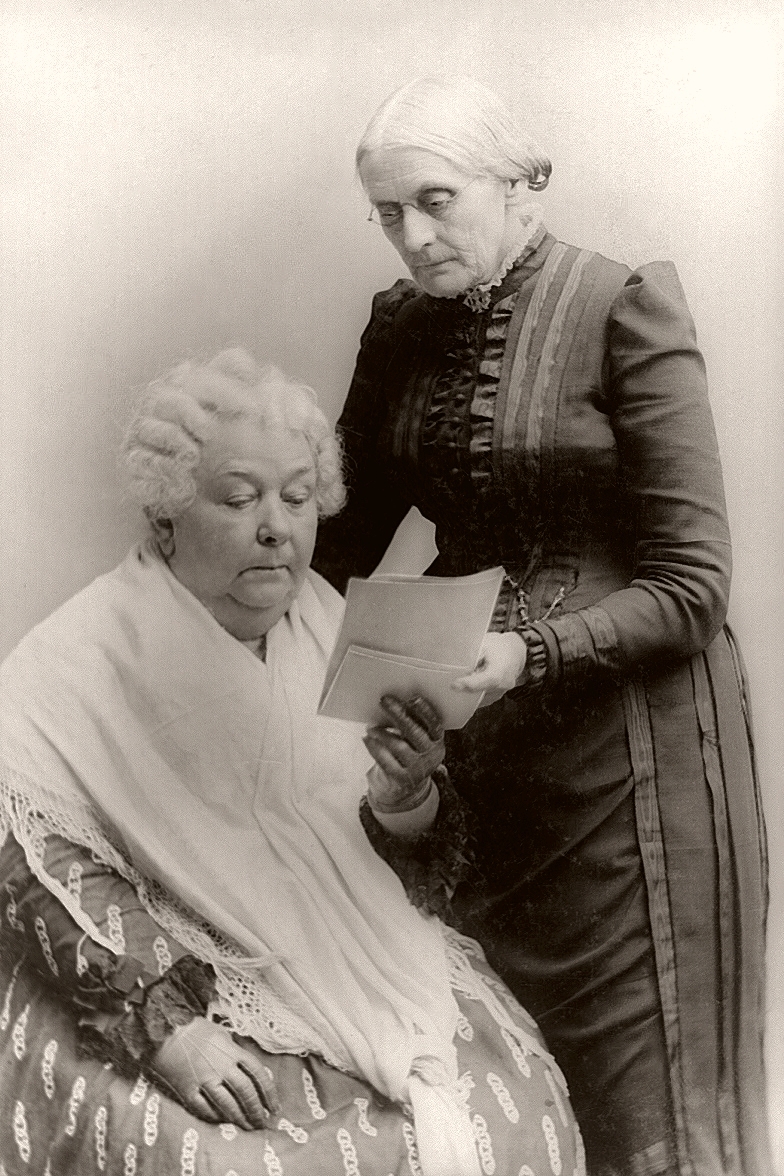
 Elizabeth Cady Stanton was born November 12, 1815 in Johnstown, New York. She was the eighth child of 11 children. However, five of her siblings died in early childhood or infancy. Another brother died at age 20. Her father was a slave owner like many other families. Elizabeth was one of the top students in her class. She married Henry Brewster Stanton in 1840. At their wedding, Elizabeth Cady refused to promise to "obey" her husband in the vows, later writing "I obstinately refused to obey one with whom I supposed I was entering into an equal relation." Stanton met Lucretia Mott, a Quaker, feminist and abolitionist, at the International Anti-Slavery Convention in London, England in 1840 during her honeymoon. In 1848 Stanton, Lucretia Mott, and a handful of other women in Seneca Falls organized the first woman's rights convention. Stanton drafted a Declaration of Sentiments, modeled on the United States Declaration of Independence, which she read at the convention. It proclaimed that men and women are created equal. It was later passed. Stanton was invited to speak at a second women's rights convention in Rochester, New York. Although best known for their joint work on behalf of women's suffrage, Stanton and Anthony first joined the Temperance Movement. Together they founded the short-lived Woman's State Temperance Society (1852-53). Stanton and Anthony's focus soon shifted to female suffrage and women's rights. After the American Civil War Stanton and Anthony broke with their abolitionist backgrounds and fought strongly against ratification of the Fourteenth and Fifteenth Amendments to the US Constitution granting African American men the right to vote. Despite these efforts, the Fourteenth Amendment was passed in 1868.In 1881, Harper & Brothers Publishers issued the first volume of The History of Woman Suffrage, a seminal, six-volume work containing the full history, documents, and letters of the woman's suffrage movement. The book was written by Stanton, Susan B. Anthony, Frances Gage, and Ida Harper. The book was completed in 1922. After 50 years working together with Anthony, Elizabeth Cady Stanton died of heart failure on October 26, 1902.
Subscribe to:
Comments (Atom)